Content
Pepole
CV

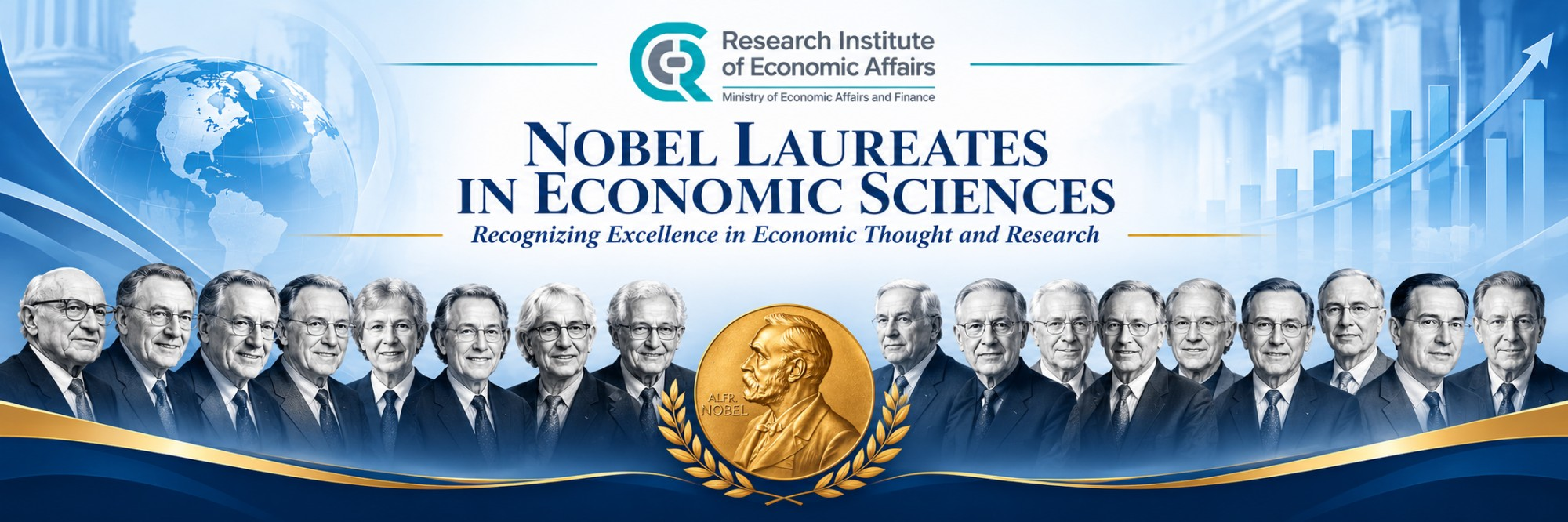
Exploring the ideas, research and intellectual contributions that have shaped modern economics. A historical archive of the laureates of the Sveriges Riksbank Prize in Economic Sciences in Memory of Alfred Nobel.
Robert E. Hall and Michael Woodford are recognized for research on the microeconomic foundations of macroeconomic stabilization. Their work strengthens the connection between the decisions of households and firms and aggregate economic outcomes.
Hall's research has examined macroeconomic behavior, labor markets and economic fluctuations. Woodford's contributions to macroeconomic theory, expectations and monetary policy have advanced the understanding of how central bank decisions influence economic performance.
Their work has helped develop theoretical frameworks for analyzing stabilization policy and the response of economies to economic shocks.
MacroeconomicsMonetary PolicyEconomic StabilizationThe 2025 Prize recognizes research explaining the role of innovation in long-term economic growth. Joel Mokyr examined the historical foundations of technological progress and the institutional and cultural conditions that support innovation.
Philippe Aghion and Peter Howitt developed the theory of creative destruction, explaining how new technologies, products and firms replace older ones and generate productivity improvements and economic growth.
Their contributions have deepened the understanding of the relationship between technological change, competition, innovation and sustained prosperity.
InnovationEconomic GrowthCreative DestructionThe laureates examined how political and economic institutions shape national prosperity. Their research explains why countries with different institutional structures often experience substantially different paths of development and income growth.
They distinguish between inclusive institutions, which broaden participation and protect economic rights, and extractive institutions, which concentrate power and opportunities among a limited group.
Their work has made major contributions to development economics and political economy by highlighting the historical roots of institutional differences and persistent inequality.
InstitutionsDevelopment EconomicsPolitical EconomyClaudia Goldin's research traced women's participation in the labour market over more than two centuries. Her historical analysis showed that women's labour force participation did not follow a simple upward path, but instead displayed a U-shaped pattern over time.
Her work also examined the gender pay gap and the influence of family decisions, occupational structures and parenthood on earnings. In particular, she highlighted how the arrival of a first child can affect women's career paths and income.
Her research has transformed the study of gender inequality and labour economics.
Labour EconomicsGender InequalityThe laureates advanced the understanding of the role of banks in the economy and the causes and consequences of financial crises. Diamond and Dybvig explained how banks transform short-term deposits into long-term lending, while also showing why this function can make banks vulnerable to runs.
Bernanke's research on the Great Depression demonstrated how bank failures and disruptions to financial intermediation intensified and prolonged economic downturns.
Their work has informed banking regulation, deposit insurance and policies designed to prevent and manage financial crises.
BankingFinancial StabilityFinancial CrisesDavid Card used natural experiments to study the effects of minimum wages, immigration and education on labour markets. His findings challenged several conventional assumptions about the relationship between wage policies and employment.
Joshua Angrist and Guido Imbens developed methodological tools that help researchers identify and measure causal relationships using observational data and natural experiments.
Their contributions strengthened empirical economics and improved the evidence base for evaluating public policy.
Labour EconomicsCausal InferenceMilgrom and Wilson improved auction theory and developed new auction formats. Wilson analyzed auctions in which bidders share uncertainty about an item's value, explaining how the winner's curse can lead participants to bid cautiously.
Milgrom extended this analysis to situations in which bidders have different private valuations and information. Their theoretical insights were applied to the design of practical auctions, including the allocation of radio frequencies.
Auction TheoryMarket DesignThe laureates transformed development economics through the use of field experiments. They divided broad questions about poverty into smaller, testable problems and evaluated interventions in education, health, nutrition and access to financial services.
Their approach demonstrated how carefully designed randomized evaluations can help policymakers identify which interventions work, for whom and under what conditions.
Development EconomicsPovertyField ExperimentsNordhaus developed methods for analyzing the interaction between economic activity and climate change, including the economic consequences of greenhouse gas emissions and climate policy.
Romer demonstrated how technological ideas and innovation can drive long-term economic growth. His work established the importance of knowledge creation and incentives in endogenous growth theory.
Climate EconomicsInnovationGrowth TheoryThaler incorporated psychological insights into economic analysis, showing that people do not always make decisions in accordance with the assumptions of perfect rationality.
His work on mental accounting, self-control and social preferences explained how behavioural biases influence saving, consumption and financial choices. The concept of nudging demonstrated how decision environments can be designed to encourage better choices without removing freedom of choice.
Behavioural EconomicsDecision-MakingHolmström developed insights into incentive contracts and the relationship between performance and compensation. His research explained how contracts can motivate effort while taking account of risk and imperfect information.
Hart advanced the theory of incomplete contracts, examining how ownership and decision-making rights should be allocated when future circumstances cannot be fully specified in advance.
Their work has influenced corporate governance, executive compensation, employment relationships and the organization of firms.
Contract TheoryCorporate GovernanceDeaton advanced the analysis of household consumption and its relationship with income, prices and saving. His work demonstrated the importance of understanding economic decisions at the household level.
By developing methods for analyzing household data, he improved the measurement of poverty and welfare. His research also showed why national averages may conceal substantial differences in living conditions and economic well-being.
Household EconomicsPoverty MeasurementTirole developed influential theoretical tools for understanding industries dominated by powerful firms. His research showed why competition policy and regulation must account for the specific characteristics of each market and the information available to regulators.
His work has contributed to the analysis of monopolies, competition, pricing, privatization and the regulation of large firms.
Industrial OrganizationRegulationFama's research showed how quickly asset prices incorporate available information. Hansen developed the generalized method of moments, an important statistical tool for testing economic models. Shiller's work demonstrated that long-term asset prices can display patterns that are difficult to explain solely through fundamental values.
Together, their contributions transformed empirical research on financial markets and asset pricing.
Financial EconomicsAsset PricingEconometricsShapley developed the mathematical foundations of stable matching, including methods for matching two groups when preferences differ. Roth applied these ideas to real-world allocation problems.
Their work has influenced the design of systems for university admissions, medical residency placements and organ donation, demonstrating how carefully designed rules can improve the allocation of scarce resources.
Game TheoryMarket DesignSargent developed structural econometric methods to examine how economic agents respond to persistent changes in policy. Sims developed vector autoregression methods that help researchers analyze the effects of economic shocks on macroeconomic variables.
Their work provided important tools for studying monetary and fiscal policy, inflation, output and employment.
MacroeconometricsEconomic PolicyThe laureates developed the theory of search and matching, explaining how unemployment and job vacancies emerge when workers and employers need time and resources to find suitable matches.
Their models have become central to modern labour economics and provide a framework for analyzing unemployment, recruitment, wages and labour market policies.
Labour EconomicsSearch and MatchingOstrom demonstrated how local communities can successfully manage shared resources such as forests, fisheries and water systems through well-designed rules and collective institutions.
Williamson examined the boundaries of firms and markets, explaining how organizational structures can reduce transaction costs and manage conflicts in economic relationships.
Institutional EconomicsGovernanceKrugman developed new trade theory by showing how economies of scale, product differentiation and market structure can explain trade between countries with similar characteristics.
His work also contributed to the development of new economic geography, explaining why economic activity tends to concentrate in particular cities and regions.
International TradeEconomic GeographyMechanism design examines how institutions and economic rules can be constructed to achieve desirable outcomes when individuals possess different information and incentives.
Hurwicz established the foundations of the field, Maskin advanced the theory of implementation and incentive compatibility, and Myerson developed important applications in auction and contract theory.
Mechanism DesignInformation EconomicsPhelps advanced the understanding of the relationship between inflation and unemployment by emphasizing the role of expectations. He showed that inflation expectations adjust over time and that policymakers cannot permanently reduce unemployment through higher inflation.
His research highlighted the importance of credibility, expectations and the long-run consequences of monetary policy.
Monetary EconomicsInflationAumann's work on repeated games explained the conditions under which cooperation can emerge and persist among competing actors. Schelling analyzed strategic interaction, bargaining, threats and commitments.
Their contributions have influenced economics as well as international relations, negotiation and the analysis of conflict.
Game TheoryStrategic InteractionKydland and Prescott developed influential frameworks for understanding business cycles and the effects of economic policy over time. Their work highlighted the importance of expectations and the problem of time inconsistency in policymaking.
They also examined the role of technological shocks in fluctuations in output and employment, shaping modern macroeconomic analysis.
Business CyclesMacroeconomic PolicyEngle developed ARCH models to analyze changing volatility in economic and financial data. These methods became important tools for measuring and forecasting financial risk.
Granger developed methods for analyzing cointegration, enabling researchers to identify meaningful long-run relationships among non-stationary economic variables.
EconometricsFinancial VolatilityKahneman integrated insights from psychology into economic analysis, especially the study of judgment and decision-making under uncertainty. His work with Amos Tversky contributed to prospect theory and a more realistic understanding of human choices.
Smith established laboratory experiments as a method for testing economic theories and studying market behaviour under controlled conditions.
Behavioural EconomicsExperimental EconomicsThe laureates showed how unequal access to information can affect market outcomes. Akerlof's analysis of the market for used cars illustrated how information asymmetry can drive high-quality products out of the market.
Spence developed signaling theory, while Stiglitz advanced the analysis of screening mechanisms. Their work transformed the study of information, incentives and market efficiency.
Information EconomicsMarket FailureHeckman developed methods for addressing sample selection problems, improving empirical research in labour economics, education and social policy evaluation.
McFadden developed econometric methods for analyzing discrete choices, such as decisions about employment, transport and residential location. Their work made microdata analysis a central part of modern applied economics.
MicroeconometricsDiscrete ChoiceMundell analyzed how monetary and fiscal policies operate under different exchange rate systems and levels of international capital mobility.
His theory of optimum currency areas examined the conditions under which several countries can benefit from sharing a common currency. His work became particularly influential in debates on monetary unions and European integration.
International EconomicsExchange RatesSen broadened the analysis of poverty and welfare beyond income and financial resources. His capability approach evaluates well-being in terms of people's real freedoms and opportunities to achieve valuable ways of living.
His research on famine and inequality also demonstrated that hunger can result from unequal access to resources rather than simply from a shortage of food.
Welfare EconomicsPovertyHuman DevelopmentMerton and Scholes developed a pioneering approach to pricing options and other financial derivatives. The Black–Scholes–Merton framework relates option values to factors such as the underlying asset price, exercise price, time to maturity, interest rates and volatility.
Their work provided essential tools for financial risk management and modern derivatives markets.
Financial EconomicsDerivativesMirrlees analyzed how taxation can be designed when governments do not have complete information about individuals' abilities and economic circumstances. His work examined the trade-off between efficiency and distributional objectives.
Vickrey made major contributions to auction theory and pricing under imperfect information, helping establish principles for designing efficient allocation mechanisms.
Public EconomicsIncentive TheoryLucas demonstrated that households and firms form expectations about future economic conditions and policy decisions when making choices. His work showed that changes in policy can alter behaviour and therefore change the relationships observed in historical data.
The Lucas critique became a fundamental principle in the evaluation of economic policy and modern macroeconomic modelling.
MacroeconomicsRational ExpectationsNash introduced the concept of Nash equilibrium, a central tool for analyzing strategic interaction. Harsanyi extended game theory to situations involving incomplete information, while Selten developed the concept of subgame-perfect equilibrium for dynamic games.
Their contributions have applications in competition, bargaining, negotiation and strategic decision-making.
Game TheoryStrategic AnalysisFogel applied quantitative methods to historical economic questions, demonstrating how statistical evidence can improve the understanding of long-term economic change.
North emphasized the role of institutions, property rights and political structures in shaping economic performance. Their work strengthened the connection between economics, history and institutional analysis.
Economic HistoryInstitutional EconomicsBecker applied economic reasoning to a wide range of human and social behaviour. His theory of human capital explained how investment in education, training and health can increase productivity and earnings.
He also applied economic analysis to family decisions, crime, discrimination and the allocation of time, expanding the scope of microeconomic research.
Human CapitalMicroeconomicsCoase explained why economic activities are sometimes organized within firms rather than through market transactions. His analysis showed that transaction costs influence the boundaries and structure of organizations.
His work on property rights and bargaining also became the foundation of the Coase theorem, a major concept in institutional economics and the analysis of externalities.
Transaction CostsInstitutional EconomicsMarkowitz developed portfolio theory, showing how investors can balance risk and return across a collection of assets. Miller's work on corporate finance examined the relationship between capital structure and firm value.
Sharpe developed the Capital Asset Pricing Model, providing a framework for understanding the relationship between systematic risk and expected returns.
Portfolio TheoryFinancial MarketsHaavelmo established important foundations for the use of probability theory in econometrics. He showed why statistical analysis of economic relationships requires an explicit probabilistic framework.
His work on simultaneous economic equations helped researchers analyze systems in which several variables influence one another at the same time.
EconometricsStatistical TheoryAllais made pioneering contributions to the theory of markets and the efficient allocation of resources. He used mathematical methods to examine market equilibrium, capital theory and decision-making under uncertainty.
His work also addressed the relationship between economic efficiency and social objectives, influencing the development of mathematical economics.
Market TheoryWelfare EconomicsSolow developed a landmark model explaining how capital, labour and technological progress contribute to economic growth. His research demonstrated that capital accumulation alone cannot explain sustained increases in income per capita.
Technological progress and productivity improvements are central to long-term growth, making his framework a foundation of modern growth theory.
Growth EconomicsProductivityBuchanan developed public choice theory, applying economic analysis to political decision-making. He argued that voters, politicians and public officials respond to incentives and interests, just as individuals do in markets.
His research emphasized the importance of constitutional rules and institutional arrangements in shaping collective decisions and limiting political discretion.
Public ChoicePolitical EconomyModigliani developed the life-cycle theory of saving, explaining how individuals distribute consumption and saving over their lifetimes. The theory became important for analyzing household behaviour and retirement systems.
His work in corporate finance, including the Modigliani–Miller framework, also influenced the understanding of capital structure and firm value.
Household SavingCorporate FinanceStone developed systematic methods for measuring national income and economic activity. His work created a coherent framework for recording production, income, consumption, saving, investment and international transactions.
These methods helped establish internationally comparable national accounts and became essential tools for macroeconomic analysis and policy design.
National AccountsMacroeconomic StatisticsDebreu used advanced mathematical methods to formalize general equilibrium theory. His work helped establish rigorous conditions under which a competitive economy can have a set of prices that balances supply and demand across markets.
His contributions strengthened the mathematical foundations of economic theory and the analysis of resource allocation under uncertainty.
General EquilibriumMathematical EconomicsStigler examined industrial structures, information costs and the effects of regulation. His work on the economics of information showed that searching for prices and product quality involves costs that influence market outcomes.
He also developed influential insights into regulatory capture, explaining how regulation can sometimes serve the interests of organized groups rather than the broader public.
Industrial OrganizationRegulationTobin analyzed how financial markets influence investment, consumption, employment and production. His portfolio theory explained how investors balance risk and expected returns when choosing among financial and real assets.
The Tobin's Q concept also provided a framework for understanding the relationship between market valuation and the cost of replacing a firm's capital.
Financial EconomicsInvestmentKlein developed large-scale econometric models that combined economic theory with statistical data to explain and forecast macroeconomic activity.
His work connected models from different countries through the LINK project, helping researchers examine international economic relationships and the transmission of fluctuations across national economies.
Econometric ModellingForecastingSchultz emphasized the role of education, skills, health and knowledge as forms of human capital that raise productivity, particularly in agriculture and developing economies.
Lewis developed the dual-sector model, explaining how labour can move from traditional agricultural activities to modern industrial sectors, supporting capital accumulation and economic development.
Development EconomicsHuman CapitalSimon challenged the assumption that individuals and organizations always make decisions with complete information and unlimited computational ability. He developed the concept of bounded rationality to explain how time, information and cognitive limitations shape real decisions.
His work introduced the idea of satisficing, in which decision-makers seek satisfactory solutions rather than necessarily identifying the theoretically optimal choice.
Decision TheoryOrganizational EconomicsOhlin developed the Heckscher–Ohlin framework, explaining how differences in countries' factor endowments influence trade patterns and specialization.
Meade analyzed international economic relations, including trade, capital flows and the conditions required to achieve internal and external balance in open economies.
International TradeOpen-Economy MacroeconomicsFriedman made major contributions to monetary economics and the development of monetarism. His research emphasized the relationship between money, output and the price level.
He also developed the permanent income hypothesis, explaining how households base consumption decisions on expected long-term income rather than current income alone.
Monetary EconomicsConsumption TheoryKantorovich developed applications of linear programming to determine efficient ways of allocating scarce resources in production and planning.
Koopmans advanced activity analysis, examining the relationships between inputs and outputs and the conditions required for efficient resource allocation. Their work influenced production planning, transport and operations research.
OptimizationResource AllocationMyrdal examined the interaction between economic, social and institutional forces, contributing to the analysis of development, inequality and poverty.
Hayek advanced monetary theory and the study of business cycles, emphasizing the role of information and price signals in coordinating decentralized economic decisions.
Monetary TheoryInstitutional AnalysisLeontief developed input–output analysis to examine the interdependence of sectors within an economy. His framework shows how the output of one industry depends on inputs supplied by other industries.
The method enables researchers to trace direct and indirect effects of changes in demand and production across the economy, making it an important tool for economic planning and structural analysis.
Input–Output EconomicsEconomic StructureHicks advanced the analysis of general equilibrium and the relationships among markets, consumption, production and capital. Arrow strengthened the mathematical foundations of equilibrium theory and made major contributions to welfare economics and social choice theory.
His impossibility theorem demonstrated fundamental limits on translating individual preferences into a consistent collective social preference under a set of reasonable conditions.
General EquilibriumWelfare EconomicsKuznets developed methods for measuring national income and analyzing long-term economic growth. His work helped establish systematic approaches to measuring the size and structure of national economies.
He also examined the relationship between population, production and structural economic change, contributing to the empirical study of development.
Economic GrowthNational IncomeSamuelson advanced the use of mathematical methods in economic analysis and helped establish a unified framework for modern economic theory. His research covered consumption, welfare, capital theory, international trade, public finance and economic growth.
His textbook Economics also had a lasting influence on the teaching of economics around the world.
Economic TheoryMathematical EconomicsThe 1969 Prize was the first Sveriges Riksbank Prize in Economic Sciences in Memory of Alfred Nobel. Frisch and Tinbergen were recognized for developing and applying dynamic models to the analysis of economic processes.
Frisch helped establish econometrics as a scientific discipline by connecting economic theory, mathematics and statistical methods. Tinbergen developed and applied econometric models to study business cycles and evaluate economic policies.
EconometricsDynamic Models